Download 2022 KS1 Phonics screening check papers for Year 1. Includes practice papers, assessment/pupil’s material, answer sheet, assessment & reporting arrangements, and scoring guidance. Prepared and published by the Standards and Testing Agency.
2022 Phonics Screening Check Papers
Pupils’ materials

Phonics Screening Check Pupil’s Material
No of Pages: 24
Answer Sheet
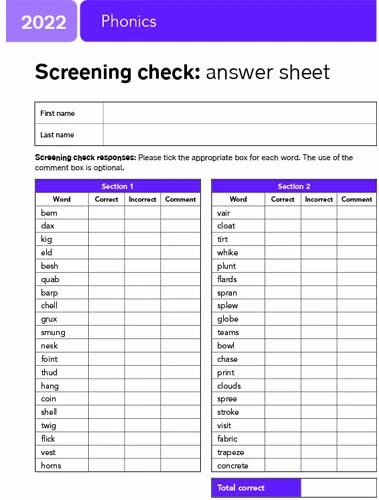
Phonics Screening Check Answer Sheet
Number of Pages: 01

Practice sheet

Phonics Screening Check Practice Sheet
Number of Pages: 02
The 2022 Phonics Screening Check: Pupils’ Materials – Standard is part of the national curriculum assessments for Key Stage 1 in England. It is designed to assess Year 1 pupils’ ability to decode and blend sounds to read both real and pseudo (nonsense) words. The check helps teachers identify children who need extra support with their phonics knowledge before moving on to more complex reading skills.
Summary
- Purpose: To evaluate pupils’ phonics proficiency.
- Structure:
- Section 1: A mix of pseudo-words (e.g., bem, dax, grux) and real words (e.g., thud, coin, twig).
- Section 2: More advanced pseudo-words (e.g., vair, whike, splew) and real words (e.g., globe, visit, trapeze).
- Format: One-to-one with a teacher, pupils read aloud the words presented.
- Outcome: Results help determine whether pupils meet the expected phonics standard or require further teaching support.
Frequently Asked Questions
Q1. What is the purpose of the Phonics Screening Check?
The check ensures pupils have developed secure phonics knowledge, enabling them to read with confidence and accuracy.
Q2. Why are there pseudo words included?
Pseudo-words test a child’s ability to apply phonics rules rather than relying on memory of familiar words.
Q3. Who sits the phonics check?
Typically, all Year 1 pupils in England. Pupils who did not meet the expected standard in Year 1 retake it in Year 2.
Q4. How is the check administered?
It is carried out individually by the class teacher in a calm and supportive setting. Pupils read the words aloud while the teacher records responses.
Q5. Is the check a formal exam?
No, it is a short assessment (around 5–10 minutes per pupil) designed to identify learning needs, not to rank or label children.
Guidance for Teachers & Parents
- Teachers:
- Use results diagnostically to plan further phonics support.
- Keep the environment calm and encouraging during administration.
- Parents:
- Support phonics at home through daily reading.
- Use flashcards, phonics games, or apps to practise decoding.
- Reassure children – the check is about learning, not pressure.